
Concrete Driveway Cost Calculator
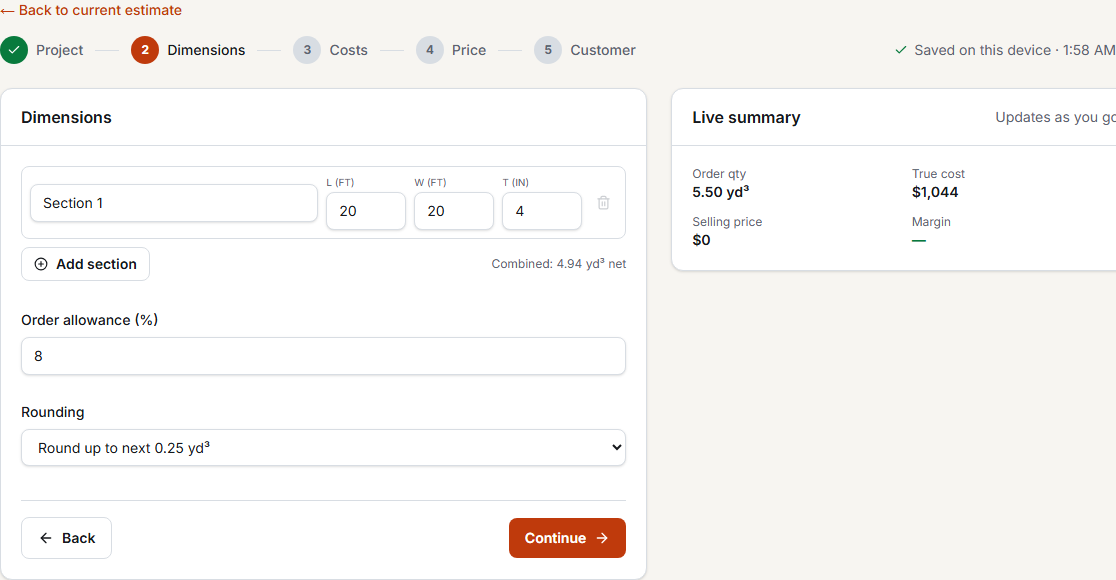
Enter your driveway dimensions and material and labor costs to see the concrete order quantity, total project cost and the price you need to charge to hit your margin.
Free to use · No signup · Uses your own prices · Results update instantly
Project Dimensions
Cost Inputs
Project Estimate
Target margin is the percentage of the selling price remaining after estimated job costs. It's different from markup.
Your current margin is 24%. Consider raising your price to $12,305 to reach at least 30%.
Want to check every standard rate against your target?
Concrete Cost Pro compares saved service rates with your current costs and shows which ones may need review.
- Compare every standard rate against your target margin
- See exactly which rates fall short
- Get the price needed to fix it
$79 one-time purchase · No monthly subscription · 14-day refund
- No sign-up required
- Free calculators, no purchase needed
- One-time payment for Pro, no subscription
- Your data stays on your device
What affects concrete driveway cost
The calculator above gives you a real number from your own inputs. Here's what typically drives those numbers up or down, so you know what to look for on your specific job.
Thickness and vehicle load
A driveway that only sees cars can often be thinner than one that regularly takes a truck, RV or trailer. More thickness means more concrete and more cost, so this is usually the single biggest lever on price.
Base preparation and excavation
Removing old asphalt or concrete, grading, and compacting a gravel base all add labor and equipment time before the pour even starts. A driveway on soft or uneven soil typically needs more base work than one on solid, level ground.
Finish
A broom finish is the standard, most affordable option. Stamped patterns, exposed aggregate, or colored/stained concrete all add material and labor cost on top of the base pour.
Reinforcement
Use the reinforcement in the responsible specification. Different bar schedules, mesh sheets and placement requirements change material and crew costs; this calculator does not determine which system is appropriate.
Site access
A long driveway, a tight approach, or a truck that can't reach the pour site (requiring a pump) all add cost. Steep or sloped sites can also add forming complexity.
Local ready-mix and labor rates
Concrete pricing per yard and crew labor rates vary significantly by region and even by supplier. Enter your own numbers above rather than relying on a national average.
How this calculator works
- 1Area: length × width gives the footprint in square feet.
- 2Volume: area × thickness (converted to feet) gives cubic feet, divided by 27 to get cubic yards.
- 3Order quantity: your allowance percentage is added on top so you don't come up short on pour day, then rounded to whatever increment you choose.
- 4Cost and price: ready-mix, labor, forms, reinforcement and equipment costs are totaled, overhead is added for true cost, and the required price is solved for your target margin.
This calculator estimates quantities and costs from user-entered dimensions, specifications, allowances and prices. It does not provide structural design, engineering or building-code recommendations.
Measure driveway sections and separate replacement costs
A driveway estimate can include the main approach, an apron and widened parking areas. Measure these as non-overlapping footprints and separate any areas with a different specified thickness. The calculator above handles one rectangular section; a combined pour can be checked in the free pour tool. Replacement work also needs a separate allowance for demolition, loading, hauling and disposal.
Keep the apron and parking pad identifiable
A wide street apron or extra parking bay is easy to omit from a length-by-width shortcut. Record its footprint independently and make sure the shared edge is not counted twice. For slope or variable-depth work, use the specified quantities rather than assuming a flat rectangle captures every part.
Record removal and access expenses
Hauling the old driveway, protecting adjacent surfaces and reaching the pour with a truck or pump are different cost items. If your pump fee is already inside a supply quote, do not repeat it in equipment. Add preparation work to the relevant labor, equipment or other field.
State exactly what the customer price covers
Identify the approved footprint, specified thickness, finish, removal scope and exclusions in the estimate. A per-square-foot selling rate is only comparable when those inclusions match. Your required price comes from the entered costs and target margin; it is not a local market-price recommendation.
Worked driveway quantity example
Illustrative inputs: 60 ft × 20 ft × 4 in. This sample represents only the main rectangular driveway. Price an apron or additional pad as another section and include demolition costs only if they are part of the actual scope.
- Net concrete
- 14.815 yd³
- Selected allowance
- 8%
- Order rounded upward to 0.25 yd³
- 16.00 yd³
- Material at illustrative $165/yd³
- $2,640
Material amount excludes delivery, tax, installation and contractor margin. Sample dimensions and prices are not design or local-price guidance.
Next steps for this driveway
Calculate one order without overlapping the corner areas.
Use the same mix specification and delivery quantity for both suppliers.
List approved selling charges and deduct deposits already received.
Multi-section projects
Price the Driveway, Apron, and Extensions as One Job
- Combine a driveway, apron and extension into one project
- Reuse your saved rates across every section
- Get one required price for the whole job
Frequently asked questions
How much concrete do I need for a driveway?
Multiply length by width to get square footage, multiply by your thickness in feet to get cubic feet, then divide by 27 to get cubic yards. This calculator does that automatically and adds your order allowance so you don't come up short on pour day.
What thickness should my driveway be?
This tool doesn't set thickness for you. Enter the thickness you or your engineer specified for the project. Standard residential driveways are commonly poured thicker than sidewalks to handle vehicle loads, but the correct spec depends on soil, climate and vehicle weight.
What's a typical order allowance?
Many contractors order 5–10% extra to cover subgrade irregularities, spillage and form variance. Set whatever allowance matches your site conditions and crew's experience.
Does this calculator include excavation or base prep?
No. It calculates concrete quantity, materials, labor and equipment costs you enter. Add excavation, gravel base or removal costs to Labor, Equipment or Other as needed.