
Concrete Slab Cost Calculator
Calculate concrete quantity and total cost for a slab pour, including garage floors, shed pads and foundations, and see the price required to hit your target margin.
Free to use · No signup · Uses your own prices · Results update instantly
Project Dimensions
Cost Inputs
Project Estimate
Target margin is the percentage of the selling price remaining after estimated job costs. It's different from markup.
Your current margin is 25%. Consider raising your price to $11,566 to reach at least 30%.
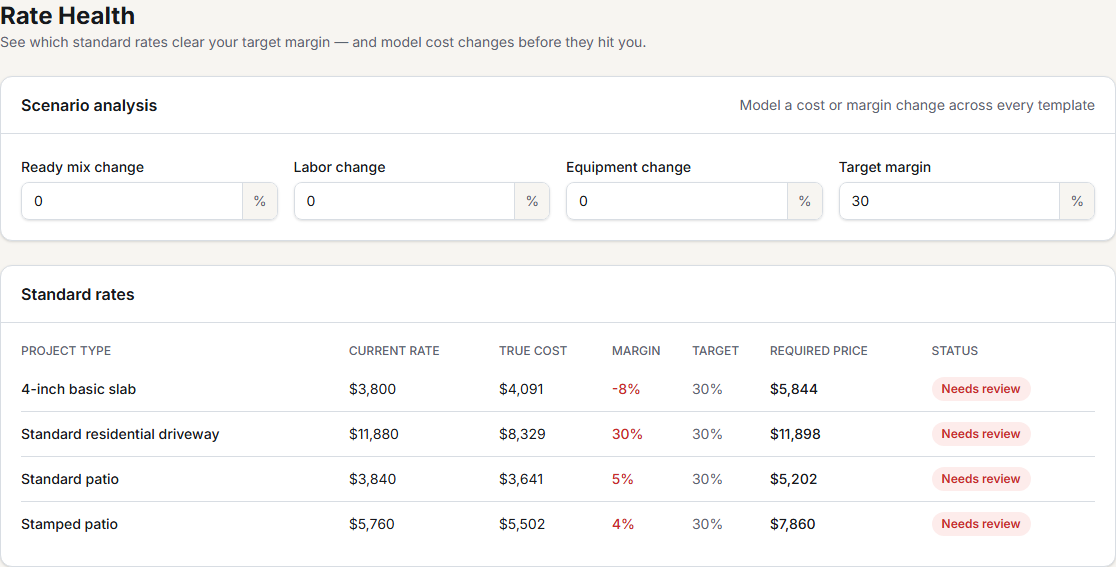
Want to check every standard rate against your target?
Concrete Cost Pro compares saved service rates with your current costs and shows which ones may need review.
- Compare every standard rate against your target margin
- See exactly which rates fall short
- Get the price needed to fix it
$79 one-time purchase · No monthly subscription · 14-day refund
- No sign-up required
- Free calculators, no purchase needed
- One-time payment for Pro, no subscription
- Your data stays on your device
What affects concrete slab cost
The calculator above gives you a real number from your own inputs. Here's what typically drives those numbers up or down, so you know what to look for on your specific job.
Intended use
A shed pad, a garage floor and a structural foundation slab all carry different load requirements, which drive thickness and reinforcement, and therefore concrete volume and cost.
Base preparation
Vapor barriers, gravel base depth, and grading/compaction all add labor before the pour. Slabs over poor-draining soil often need more base work than slabs on well-drained ground.
Finish
A basic broom or trowel finish is the cheapest option. Sealed, polished, or decorative finishes add material and labor time.
Reinforcement
Wire mesh, rebar, or fiber-reinforced mix are common options, each with a different material and placement cost, and each suited to different load and crack-control needs.
Site access
Slabs that need a pump truck (due to distance from the street, obstacles, or grade) cost more than a direct chute pour.
Local ready-mix and labor rates
Ready-mix pricing and crew rates vary by region and supplier. Always price with your own current numbers rather than a rule of thumb.
How this calculator works
- 1Area: length × width gives the footprint in square feet.
- 2Volume: area × thickness (converted to feet) gives cubic feet, divided by 27 to get cubic yards.
- 3Order quantity: your allowance percentage is added on top so you don't come up short on pour day, then rounded to whatever increment you choose.
- 4Cost and price: ready-mix, labor, forms, reinforcement and equipment costs are totaled, overhead is added for true cost, and the required price is solved for your target margin.
This calculator estimates quantities and costs from user-entered dimensions, specifications, allowances and prices. It does not provide structural design, engineering or building-code recommendations.
Scope the slab beyond its rectangular footprint
The slab calculator measures a rectangular volume from the thickness you supply. Thickened edges, separate pads and other changes in geometry need their own measured or specified quantities. It does not design a foundation or decide whether a slab needs a vapor barrier, reinforcement or any particular concrete strength. Include the specified work in your estimate so quantity and labor describe the same job.
Separate depth changes and excluded areas
A uniform slab footprint does not automatically account for edge beams or deeper strips. Measure non-overlapping portions with their appropriate specified depths. For openings, calculate the remaining area as positive sections; do not count the excluded space as poured concrete.
Account for preparation and finish work
Base preparation, placing the specified vapor barrier, finishing, curing tasks and return visits can use material and crew time beyond the concrete delivery. Enter those agreed tasks once under the relevant cost fields. A polished floor and a simple utility pad should not share an assumed labor amount.
Check the unit rate against the complete scope
Square-foot pricing can hide fixed costs on a small pad or extra finish work on a large floor. Compare the total price with the fully entered job cost. The target-margin solver divides true cost by one minus your selected margin, rather than adding that margin as a markup.
Worked slab quantity example
Illustrative inputs: 40 ft × 30 ft × 4 in. The example is a uniform rectangular slab. It excludes any thickened edge, footing or opening and uses illustrative thickness and rate inputs rather than design or market guidance.
- Net concrete
- 14.815 yd³
- Selected allowance
- 8%
- Order rounded upward to 0.25 yd³
- 16.00 yd³
- Material at illustrative $165/yd³
- $2,640
Material amount excludes delivery, tax, installation and contractor margin. Sample dimensions and prices are not design or local-price guidance.
Next steps for this slab
Use different specified depths where the rectangular geometry changes.
Convert known reinforcement, form and other quantities into purchases.
Check the order's supplier total rather than the material-only rate.
Reusable slab templates and standard-rate health
Know Whether Your Standard Slab Rate Still Reaches Its Target
- Save this as a reusable slab template
- Check it against your target margin any time costs change
- See every standard rate that needs review, in one place
Frequently asked questions
How is slab concrete volume calculated?
Area (length × width) is multiplied by thickness (converted to feet), then divided by 27 to convert cubic feet to cubic yards. An order allowance is added on top for waste and subgrade variance.
Does this tool tell me what slab thickness or reinforcement I need?
No. Slab thickness, rebar/mesh spacing and concrete strength are structural decisions that depend on load, soil and local code. Enter the specification you or your engineer already determined; this tool only calculates quantity, cost and pricing from those numbers.
What's included in 'true cost'?
True cost is your direct costs (ready mix, labor, forms, reinforcement, equipment, other) plus your overhead percentage. It's the number your selling price needs to beat to hit your target margin.