
Concrete Sidewalk Cost Calculator
Calculate concrete quantity and cost for a sidewalk or walkway pour and see the price required to hit your target margin.
Free to use · No signup · Uses your own prices · Results update instantly
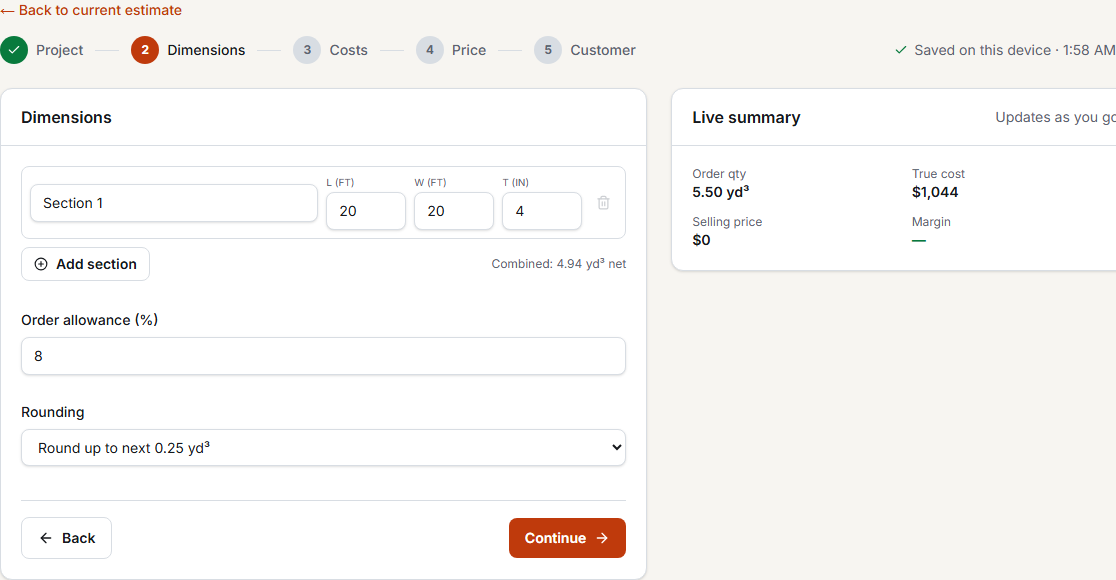
Project Dimensions
Cost Inputs
Project Estimate
Target margin is the percentage of the selling price remaining after estimated job costs. It's different from markup.
Your current margin is -7%. Consider raising your price to $5,202 to reach at least 30%.
Want to check every standard rate against your target?
Concrete Cost Pro compares saved service rates with your current costs and shows which ones may need review.
- Compare every standard rate against your target margin
- See exactly which rates fall short
- Get the price needed to fix it
$79 one-time purchase · No monthly subscription · 14-day refund
- No sign-up required
- Free calculators, no purchase needed
- One-time payment for Pro, no subscription
- Your data stays on your device
What affects concrete sidewalk cost
The calculator above gives you a real number from your own inputs. Here's what typically drives those numbers up or down, so you know what to look for on your specific job.
Length and required width
Municipal specs often set a minimum sidewalk width. Check local requirements before pricing, since a wider strip directly increases concrete volume.
Control joints and finish
Sidewalks need regular control joints to manage cracking, which adds labor time versus a single continuous slab.
ADA ramps and crossings
Curb ramps and street crossings usually require detectable warning surfaces and tighter slope tolerances, both of which add labor and material cost over a plain flat run.
Base preparation
Public sidewalks typically need a compacted gravel base to meet inspection standards, adding site work before the pour.
Permitting and inspection
Work in the public right-of-way often requires permits, traffic control, and inspection sign-off: real costs that belong in your estimate.
How this calculator works
- 1Area: length × width gives the footprint in square feet.
- 2Volume: area × thickness (converted to feet) gives cubic feet, divided by 27 to get cubic yards.
- 3Order quantity: your allowance percentage is added on top so you don't come up short on pour day, then rounded to whatever increment you choose.
- 4Cost and price: ready-mix, labor, forms, reinforcement and equipment costs are totaled, overhead is added for true cost, and the required price is solved for your target margin.
This calculator estimates quantities and costs from user-entered dimensions, specifications, allowances and prices. It does not provide structural design, engineering or building-code recommendations.
Estimate walkway runs, crossings and restoration separately
A sidewalk estimate starts with the actual measured runs and their specified widths and thicknesses. A narrow straight path is not the same scope as a crossing, ramp or right-of-way repair. Break changes in width or depth into non-overlapping sections, and price any separate features from the responsible specification. This tool does not set accessibility slopes, joint spacing or municipal construction requirements.
Separate runs with different geometry
Measure the straight walkway, widened crossing and other portions individually where dimensions change. Use the pour calculator to total rectangular sections. Ramps or irregular transitions need the appropriate measured volume rather than a flat-strip shortcut.
Include non-pour obligations
Traffic management, permits, inspection scheduling, excavation, hauling and surrounding restoration may belong to the job scope. They consume money even when they add no concrete volume. Enter their quoted costs in labor, equipment or other and explain included work in the customer document.
Allow for handling and finish time
A long narrow path can require more moving and edge-form work per square foot than a broad pad. Price the crew time needed for access, the specified finish and joint work. Use your own rates; the sample labor input is a calculation example rather than a productivity benchmark.
Worked sidewalk quantity example
Illustrative inputs: 100 ft × 4 ft × 4 in. The sample assumes one uniform rectangular walkway. It excludes ramps, crossings and restoration unless you add their quantities and costs separately.
- Net concrete
- 4.938 yd³
- Selected allowance
- 6%
- Order rounded upward to 0.25 yd³
- 5.25 yd³
- Material at illustrative $165/yd³
- $866
Material amount excludes delivery, tax, installation and contractor margin. Sample dimensions and prices are not design or local-price guidance.
Next steps for this sidewalk
Calculate allowance and rounding for the complete delivery group.
Round known material requirements to actual purchase increments.
Show the agreed charges, received payments and remaining balance.
Multi-section projects
Combine Multiple Sidewalk Sections and Price the Complete Job
- Combine multiple sidewalk runs into one project
- Reuse your saved rates across every section
- Get one required price for the whole job
Frequently asked questions
Do municipal sidewalk jobs need different allowances?
Public right-of-way work often has stricter finish and joint requirements. Adjust labor and other costs to reflect inspection, traffic control or permit costs specific to the job.