
Free contractor tool
Concrete Material Calculator
Turn known material takeoff quantities into a purchase list. Enter concrete, formwork, specified reinforcement or other materials, apply a separate allowance to each and round purchases to the increments you can actually buy.
No signup · Uses your own inputs · No automatic cloud storage
Sample takeoff quantities and USD rates. Replace them with your specified material schedule.
Material 1
Material 2
Material 3
Material purchase schedule
Ready-mix concrete
Buy 5.500 yd³ · $907.50
Form boards
Buy 136.000 linear ft · $272.00
Specified reinforcement
Buy 420.000 linear ft · $336.00
Unit cost is per unit shown, not per pack. Delivery, tax, labor and equipment are excluded. No reinforcement layout or mix design is inferred.
How to use this calculator
- Take the net quantity for each material from your measurements or specified material schedule. Enter its unit, such as yd³, linear feet, sheets or each.
- Set a waste or order allowance for that material. If your quantity already includes allowance, use 0% so it is not added twice.
- Enter the purchase increment in the same unit: 8 for an 8-foot board, 20 for a 20-foot bar, or 0.25 for quarter-yard concrete orders.
- Enter cost per unit, not per pack. Review the rounded purchase quantities and total material cost, then add delivery and installation separately.
Example: purchasing from a specified material schedule
The takeoff quantities and rates are examples. Reinforcement dimensions and quantities must come from the applicable specification; the tool does not design a bar layout.
| Calculation or charge | Result |
|---|---|
| Concrete: 5 yd³ + 8%, next 0.25 yd³ | 5.50 yd³ × $165 = $907.50 |
| Form boards: 120 ft + 10%, next 8 ft | 136 ft × $2 = $272.00 |
| Specified bars: 400 ft + 5%, next 20 ft | 420 ft × $0.80 = $336.00 |
| Total material purchase cost | $1,515.50 |
An 8-foot board costing $16 has a cost of $2 per linear foot. Entering $16 as the per-foot cost would multiply the intended amount by eight. Keep quantity, purchase increment and unit cost in matching units.
A purchase schedule is different from mix design
This tool answers how much of a listed material to purchase and what it costs. It starts with your known takeoff quantity. It does not determine cement, sand, aggregate or water proportions, specify reinforcement spacing, or substitute for a structural material schedule.
Ready-mix quantity can come from the pour calculator. Form-board length, reinforcement totals, mesh sheets and other material quantities should come from measurements or the specified design. Because these are different units, the result keeps each material on its own row rather than adding incompatible quantities into one total.
Round each material to the units you can buy
Purchase quantity = round upward to the purchase increment after applying the selected allowance. A 132-foot board requirement bought in 8-foot lengths becomes 136 feet. That is a purchasing total; it does not prove that a particular cutting layout will fit within 17 boards.
Lengths lost to cuts, reinforcement laps, concrete allowance and sheet offcuts are different sources of additional material. Enter the known requirements and allowances appropriate to each line. Do not assume a single waste percentage works for every material, and do not add a second allowance to a schedule that already includes it.
Keep purchase cost separate from delivery and labor
The price field is cost per unit displayed on the line. Divide a pack price by the number of units in the pack before entering it. For a $90 sheet, use unit ‘sheet’ and cost $90; for a $16 board measured in feet, use linear-foot cost instead.
The material total excludes tax, delivery, equipment and placement labor. Include those once in your overall job cost. When pricing a supplier concrete order with short-load and delivery charges, use the ready-mix calculator so those fees are visible rather than buried in the material quantity or rate.
Continue your concrete workflow
Get geometric concrete volume before applying this schedule's allowance.
Use the final concrete order quantity to calculate full procurement cost.
Convert purchases into a complete contractor job-cost and pricing calculation.
Bill your customer after completion using selling charges, not these internal purchase costs.
Concrete Cost Pro · One-time purchase
Reuse material rates across future estimates
Concrete Cost Pro keeps reusable material, labor and equipment rates in a local catalog. Build project templates from your own costs, combine sections into the current estimate and calculate a customer price using overhead and target margin. Export your reusable business data regularly for backup.
See the Pro catalog and templates$79 lifetime launch price · Regularly $99 · No monthly subscription
See Concrete Cost Pro features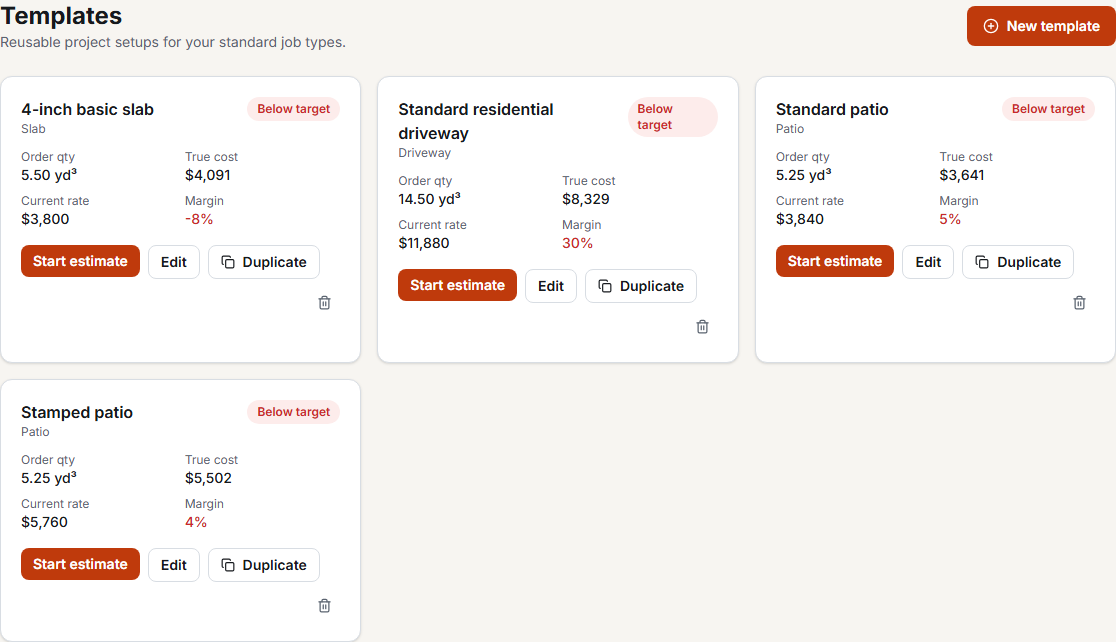
Concrete Material Calculator questions
Does this calculate cement, sand and gravel proportions?
No. It builds a purchase schedule from your known specified quantities. It is not a concrete mix-design calculator and does not recommend ingredient proportions.
Can I calculate reinforcement requirements?
You can calculate a purchase quantity and cost from an already-specified reinforcement total. The tool does not determine bar sizes, spacing, laps, structural adequacy or code compliance.
What if I already added waste to my takeoff?
Enter the adjusted quantity and set waste to 0%. Purchase rounding can still apply, but the percentage will not be added again.
Does purchase rounding optimize board or bar cuts?
No. It rounds the total required length to your purchase increment. A cutting list can require more stock depending on individual lengths and offcuts; verify it separately.